Student Loan Consolidation: Complete Guide to Lower Payments & PSLF Access
Student loan consolidation is a federal repayment strategy in which borrowers combine multiple student loans into a single loan with a fixed interest rate. For borrowers juggling multiple servicers, varying due dates, and rising monthly payments, consolidation offers relief, simplicity, and access to forgiveness programs.
Consolidation is especially helpful for borrowers with older FFEL or Perkins loans, private collection issues, or those needing PSLF eligibility.
What Is Student Loan Consolidation?
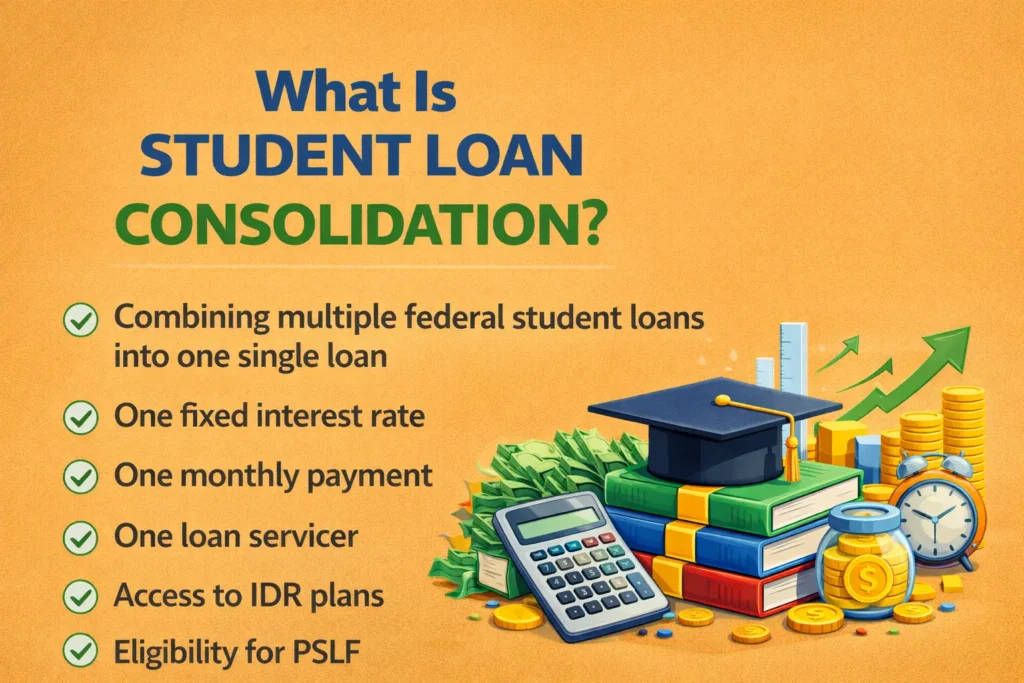
Student loan consolidation means merging multiple federal loans into a Direct Consolidation Loan. This is done through the Department of Education and comes with:
- One fixed interest rate
- One monthly payment
- Access to IDR plans
- PSLF eligibility
For a deeper understanding of loan categories, check:
👉 Federal vs private student loans
How Student Loan Consolidation Works?
1. Check Eligible Loan Types
You can consolidate:
- Direct Loans
- FFEL Loans
- Perkins Loans
- Graduate PLUS Loans
- Parent PLUS Loans
If your FFEL loans are in collections, read how collections work:
👉 How student loans are collected
2. Apply for a Direct Consolidation Loan Online
Apply through StudentAid.gov → choose servicer → choose repayment plan → review → submit.
3. Choose an Income-Driven Repayment (IDR) Plan
Most borrowers choose:
- SAVE Plan
- PAYE
- IBR
- ICR (for Parent PLUS borrowers)
If you have medical hardship or disability issues, check:
👉 Student loan relief due to illness
4. Consolidation Approval Timeline
Approval takes 30–60 days.
Defaulted loans may take 60–90 days.
If your wages are being garnished, learn how bankruptcy can stop it:
👉 Can bankruptcy stop student loan garnishment
Key Benefits of Student Loan Consolidation
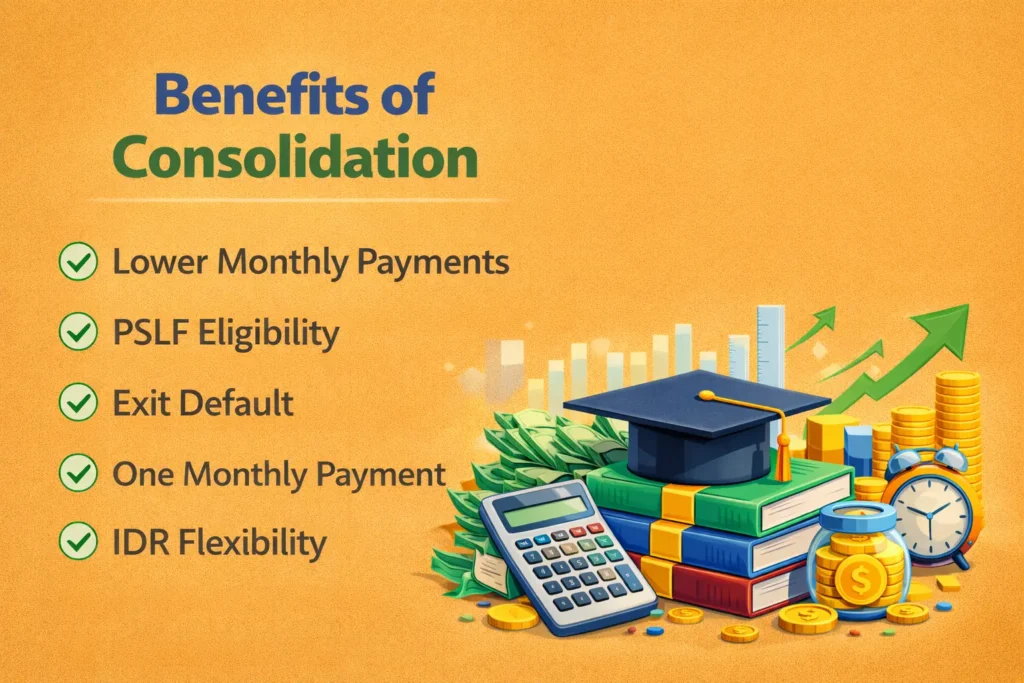
✔ Lower Monthly Payments
When paired with IDR, your monthly amount can drop significantly.
✔ Access to PSLF
Borrowers with FFEL or Perkins loans must consolidate for PSLF eligibility.
✔ Exit Default Faster
Consolidation is one of the fastest ways to stop collections.
Learn more:
👉 How student loans are collected
✔ One Monthly Payment
No more juggling multiple loan servicers.
Student Loan Consolidation vs Refinancing: Key Differences
| Feature | Consolidation (Federal) | Refinancing (Private) |
| Credit Check | ❌ Not Required | ✔ Required |
| Interest Rate | Weighted Average | Can Be Lower |
| Federal Protections | ✔ Kept | ❌ Lost |
| Private Loans | ❌ Not Allowed | ✔ Allowed |
If you want lower interest rates, check:
👉 Student loan refinance guide
How Consolidation Helps You Exit Student Loan Default
If your loan is in default, consolidation can:
- Stop wage garnishment
- Stop tax refund offset
- Stop social security offset
- Stop collection agencies
For legal-based solutions, read:
👉 Student loan bankruptcy process
👉 Chapter 7 vs Chapter 13 bankruptcy
Student Loan Consolidation vs Bankruptcy: Which Is Better?
Yes—bankruptcy can discharge student loans through an adversary proceeding.
Learn the full process:
👉 Student loan bankruptcy guide
👉 How to file an adversary proceeding
For repayment vs legal discharge comparison:
👉 Income-driven repayment vs bankruptcy
Who Should Consider Student Loan Consolidation?
Consolidation is ideal if:
- You want lower payments
- You want PSLF eligibility
- You have FFEL or Perkins loans
- You want one simple bill
- You need to exit the default
- You want access to SAVE/IDR
Pros and Cons of Student Loan Consolidation
✔ Advantages of Student Loan Consolidation
- Lower payments
- PSLF eligibility
- Stops collections
- Combines loans
- IDR access
❌ Disadvantages of Student Loan Consolidation
- May restart forgiveness clock
- The interest rate may slightly increase
- Cannot include private loans
If you have private loans, a settlement might help:
👉 Private student loan settlement
Student Loan Consolidation FAQs
Does consolidation lower interest rates?
No, only refinancing can do that.
👉 Student loan refinance guide
Can consolidation help with forgiveness?
Yes—especially PSLF and IDR forgiveness.
Can consolidation stop collections?
Yes, one of the fastest ways to end garnishment.
Can I include private loans?
No, private loans can only be refinanced.
Final Thoughts on Student Loan Consolidation
Student loan consolidation is one of the strongest tools for reducing monthly payments, accessing forgiveness, and combining federal loans into a simplified repayment structure. Whether you’re struggling with default, preparing for PSLF, or trying to make repayment more affordable, consolidation provides multiple benefits.
If you’re dealing with legal issues, bankruptcy concerns, private loan problems, or hardship-based repayment needs, refer to the internal links above for complete guides.