Federal Student Loan Debt Relief: Programs, Eligibility, Forgiveness & Application
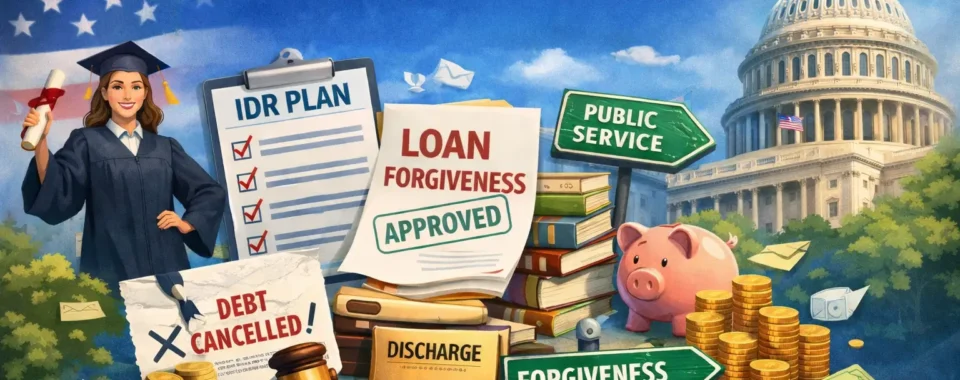
Federal student loan debt relief refers to U.S. government-backed programs that reduce, cancel, or forgive federal student loan balances through income-driven repayment plans, public service forgiveness, discharge programs, and hardship-based repayment adjustments.
Many borrowers feel overwhelmed when balances grow despite making payments. If rising interest rates, complex repayment rules, and financial pressure are affecting you, understanding federal relief programs can help you regain control of your debt and avoid long-term financial stress.
For a broader understanding of federal repayment strategies and borrower assistance, explore our comprehensive resource on
➡️ federal student loan help and repayment guidance
Summary of Federal Student Loan Debt Relief
- Federal student loan debt relief includes forgiveness, IDR plans, discharge programs, and temporary repayment adjustments.
- Public Service Loan Forgiveness (PSLF) can eliminate balances after 120 qualifying payments.
- Income-driven repayment (IDR) plans reduce monthly payments and offer forgiveness after 20–25 years.
- Eligibility depends on loan type, income, employment, and repayment history.
- Federal loans provide more relief options compared to private student loans.
How Federal Student Loan Debt Relief Works
Federal student loan debt relief is a collection of programs designed to lower payments, forgive balances, or cancel debt based on eligibility criteria.
Federal student loan debt relief is not a single program. Instead, it is a structured framework created by the U.S. Department of Education to help borrowers manage and reduce their education debt through multiple flexible repayment and forgiveness pathways.
According to this overview of the definition and structure of student loan programs, government-backed loans typically include borrower protections that allow repayment adjustments, income-based plans, and forgiveness options unavailable in private lending.
Core Types of Federal Student Loan Debt Relief Programs
- Income-Driven Repayment (IDR) Forgiveness
- Public Service Loan Forgiveness (PSLF)
- Teacher Loan Forgiveness
- Total and Permanent Disability Discharge
- Closed School and Borrower Defense Discharge
These programs collectively aim to ensure borrowers are not permanently burdened by education debt when their income, career, or life circumstances limit repayment capacity.
Federal student loan debt relief works by adjusting payments based on income, rewarding public service employment, and providing discharge options during hardship situations.
Who Qualifies for Federal Student Loan Debt Relief?
Qualification depends on loan type, income level, repayment status, employment sector, and hardship conditions.
Eligibility for federal student loan relief varies depending on the program. However, the most important requirement is having Direct Federal Loans issued or backed by the U.S. Department of Education.
Key Eligibility Requirements for Federal Relief Programs
- Loan must be a Direct Federal Student Loan
- Borrower income and family size influence IDR eligibility
- Public service employment is required for PSLF
- Consistent repayment history improves approval chances
- Disability or school closure qualifies for discharge programs
Borrowers who are unsure about their loan classification should review the detailed comparison in our guide on
➡️federal vs private student loan differences and relief options
This guide specifically covers the United States federal student loan system, where repayment is managed nationwide, and relief programs are offered in USD under federal education policies.
To qualify for federal loan relief, borrowers must hold eligible federal loans and meet income, employment, or hardship-based criteria.
Can Federal Student Loans Be Fully Forgiven?
Yes, federal student loans can be fully forgiven through PSLF, IDR forgiveness, and specific discharge programs if eligibility rules are met.
Full loan forgiveness is achievable but requires strict compliance with program conditions. Borrowers must follow repayment guidelines, maintain qualifying employment if required, and submit documentation accurately.
Main Pathways to Full Federal Student Loan Forgiveness
- Public Service Loan Forgiveness (PSLF)
- Income-Driven Repayment Forgiveness (20–25 years)
- Total and Permanent Disability Discharge
- Borrower Defense to Repayment Claims
The most widely used forgiveness route is income-driven repayment, which adjusts payments based on income and eventually forgives remaining balances. To understand this repayment structure in detail, read our in-depth breakdown of
➡️ Income-driven repayment (IDR) plans explained
Complete forgiveness is possible, but it requires long-term adherence to repayment plans or qualifying employment conditions.
Are Income-Driven Repayment (IDR) Plans the Best Debt Relief Strategy?
IDR plans reduce monthly payments based on income and offer forgiveness after 20–25 years, making them one of the most accessible relief options.
Income-driven repayment plans are designed to ensure that student loan payments remain affordable relative to borrower earnings. These plans calculate monthly payments using discretionary income and family size, which helps prevent default during periods of low income.
Major Income-Driven Repayment (IDR) Plans
- SAVE Plan
- Pay As You Earn (PAYE)
- Income-Based Repayment (IBR)
- Income-Contingent Repayment (ICR)
Benefits and Limitations of IDR Plans
| Benefits | Limitations |
| Lower monthly payments | Longer repayment period |
| Protection against default | Interest may still accumulate |
| Forgiveness after 20–25 years | Annual income recertification required |
Interest accumulation is one of the main reasons balances increase even during repayment. You can explore this in our analysis of
➡️ How student loan interest actually works over time
IDR plans are ideal for borrowers seeking affordable payments and long-term forgiveness, though they require consistent income updates each year.
Fastest Ways to Get Federal Student Loan Debt Relief
The fastest relief typically comes from enrolling in IDR plans, qualifying for PSLF employment, or applying for hardship deferment options.
While total forgiveness takes time, immediate relief can be achieved by lowering monthly payments and preventing interest-driven balance growth.
Fast Relief Strategies for Federal Student Loan Borrowers
- Enroll in an income-driven repayment plan immediately
- Certify qualifying public service employment early
- Consolidate older FFEL loans into Direct Loans
- Submit forgiveness eligibility forms without delay
Borrowers often see significant payment reductions after switching to income-based repayment, especially when their earnings fall below national median income levels.
Quick relief focuses on reducing monthly obligations first, then working toward long-term forgiveness eligibility.
Federal Student Loan Forgiveness vs Cancellation vs Discharge
Forgiveness occurs after meeting repayment requirements, cancellation is linked to service-based roles, and discharge applies to hardship or exceptional cases.
Understanding these distinctions helps borrowers choose the correct relief pathway and avoid applying for programs they may not qualify for.
Key Differences Between Forgiveness, Cancellation, and Discharge
- Forgiveness: Remaining balance erased after required payments
- Cancellation: Debt removed due to public service employment
- Discharge: Debt eliminated due to disability, school closure, or fraud
For deeper insight into why balances sometimes grow despite regular payments, review our detailed explanation on
➡️Why student loan balances grow rapidly in the United States
Choosing the right pathway—forgiveness, cancellation, or discharge—depends on career path, repayment duration, and hardship circumstances.
Step-by-Step Guide to Apply for Federal Student Loan Debt Relief
Check loan type, select the right program, submit application, verify income or employment, and track approval progress.
Step 1: Confirm Your Federal Loan Type
Log in to your federal student aid account and verify whether your loans are Direct Loans eligible for forgiveness programs.
Step 2: Select the Most Suitable Relief Program
- Low income → Income-Driven Repayment
- Public service job → PSLF
- Long-term hardship → Discharge programs
Step 3: Submit Applications and Documentation
Provide proof of employment, income records, and relevant eligibility documents.
Step 4: Track Progress and Recertify Annually
Most programs require annual recertification of income or employment status to maintain eligibility.
The application process is straightforward but requires accurate documentation and consistent follow-up.
Where to Get Trusted Help for Federal Student Loan Debt Relief
Borrowers should rely on official federal resources, verified counseling services, and credible student loan guidance platforms.
For structured guidance on eligibility checks and repayment planning, explore our dedicated hub for
➡️student loan help resources and relief strategies
If you need personalized assistance or professional consultation regarding your repayment and forgiveness options, you can directly
➡️contact our federal student loan support team
Professional guidance reduces errors, improves approval chances, and ensures borrowers choose the most beneficial relief program.
What Matters Most About Federal Student Loan Debt Relief
Federal student loan debt relief is a comprehensive system designed to protect borrowers from long-term financial hardship. Whether through income-driven repayment, public service forgiveness, or hardship-based discharge programs, these solutions help ensure that education debt remains manageable and eventually reducible.
However, borrowers must carefully evaluate eligibility criteria, repayment timelines, and long-term financial goals before choosing a relief pathway. A well-planned strategy can significantly lower monthly payments and ultimately lead to full loan forgiveness.
For borrowers exploring alternative strategies or comparing federal and private loan resolution approaches, review our guide on
Frequently Asked Questions About Federal Student Loan Debt Relief
Who qualifies for federal student loan forgiveness?
Borrowers with Direct Loans enrolled in qualifying repayment plans and working in eligible sectors like public service generally qualify for forgiveness programs.
Can federal student loans be forgiven after 10 years?
Yes, Public Service Loan Forgiveness eliminates remaining balances after 120 qualifying payments over ten years of eligible public service employment.
Are income-driven repayment plans worth it?
They are beneficial for borrowers needing lower monthly payments and long-term forgiveness based on income affordability.
Do federal loans offer more relief than private student loans?
Yes, federal loans provide structured forgiveness, discharge programs, and income-based repayment protections not commonly offered by private lenders.
What if I don’t qualify for forgiveness?
You can still reduce payments through IDR plans, consolidation strategies, or alternative repayment restructuring approaches.
Can I apply for multiple relief programs?
Yes, but you must independently meet each program’s eligibility requirements to benefit from multiple relief pathways simultaneously.
Is student loan discharge automatic?
No, borrowers must apply and submit documentation verifying eligibility for hardship-based discharge programs.